




Biography
Yuqi Chen is an Assistant Professor jointly appointed at the Hong Kong Institute for the Humanities and Social Sciences and the Faculty of Arts at the University of Hong Kong. She obtained both her BA and PhD degrees from Peking University and was a visiting scholar at the Institute for Quantitative Social Science, Harvard University.
She works actively in the fields of Quantitative History and Digital Humanities. Her research integrates artificial intelligence and computational methods with humanities research, aiming to generate fresh insights through innovative interdisciplinary approaches.
Her current research interests fall into three main areas:
- Quantitative History and Archaeology – Utilising quantitative methods, such as spatial analysis, time series analysis, and social network analysis, and developing open-source computational tools, to advance archaeological and historical research, particularly in the Early China period.
- AI for the Humanities – Employing artificial intelligence to digitise and interpret low-resource historical materials, including oracle bones, bronze inscriptions, and premodern Chinese texts.
- Historical Psychology – Using AI-driven methods to explore human sentiment and trace the long-term evolution of cultural psychology.
She serves as a reviewer for leading journals in the humanities and social sciences, including Nature Human Behaviour, Humanities and Social Sciences Communications, Digital Scholarship in the Humanities, Current Research in Ecological and Social Psychology, and Applied Geography, among others. She is also a Consulting Editor for Human Nature. Her work has appeared in journals such as International Journal of Geographical Information Science, Humanities and Social Sciences Communications, and Digital Scholarship in the Humanities, as well as at conferences including the Digital Humanities (DH) Conference and the Conference on Empirical Methods in Natural Language Processing (EMNLP), among other leading venues.
At the Centre for Quantitative History, Yuqi Chen plays a pivotal role in the construction of two major databases, leading the development of computational frameworks and digital resources to support large-scale interdisciplinary studies of Chinese archaeology and social history.

Related News
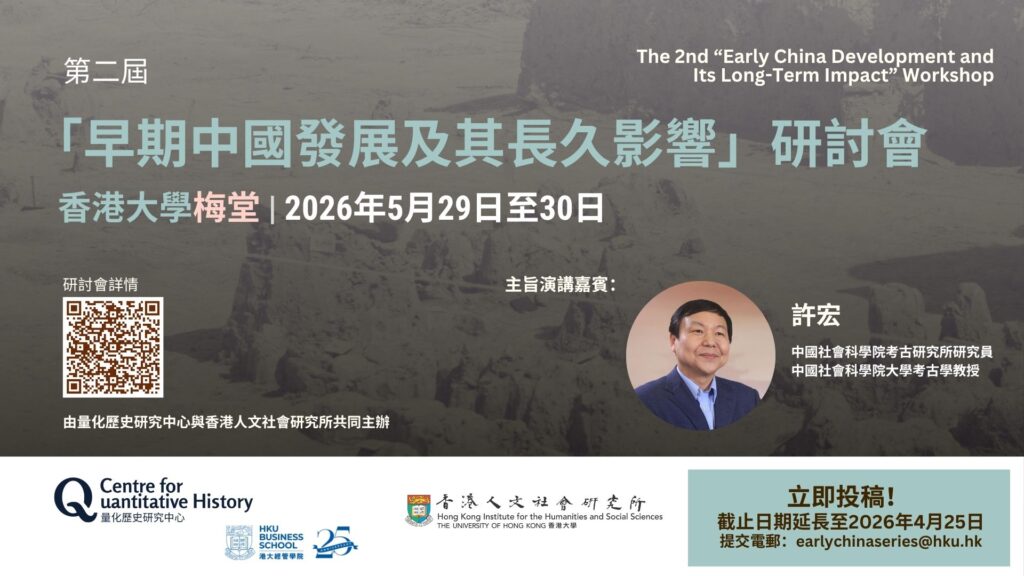
 February 14, 2026
 Announcement
Related Publication and Projects

Extracting geographic information from historical texts presents unique challenges. To address these challenges, this study leverages generative large language models (LLMs) to extract historical toponyms and their corresponding location references from texts. The coordinates of the extracted toponyms are then identified by a historical geocoder, which also calculates their maximum error distances based on the location references, indicating the degree of uncertainty. Both the extraction and geocoding processes are integrated into a novel tool named ‘His-Geo’ (https://github.com/yukiyuqichen/His-Geo). To evaluate the results, this study also curates a manually annotated dataset, the Early China Historical Geographic Corpus (CHGC-Early), filling the gap in the absence of geographic data for early China in existing gazetteers and providing a benchmark dataset for training and evaluating approaches for tasks related to geographic information extraction from premodern Chinese texts. The evaluation results show a satisfactory 0.831 F1 score for the GPT-4o model, demonstrating the remarkable capability of generative large language models in extracting geographic information from lengthy, unstructured texts that encompass diverse and sometimes conflicting views.
April 25, 2025 Journal Publications