



 June 29, 2026
 News
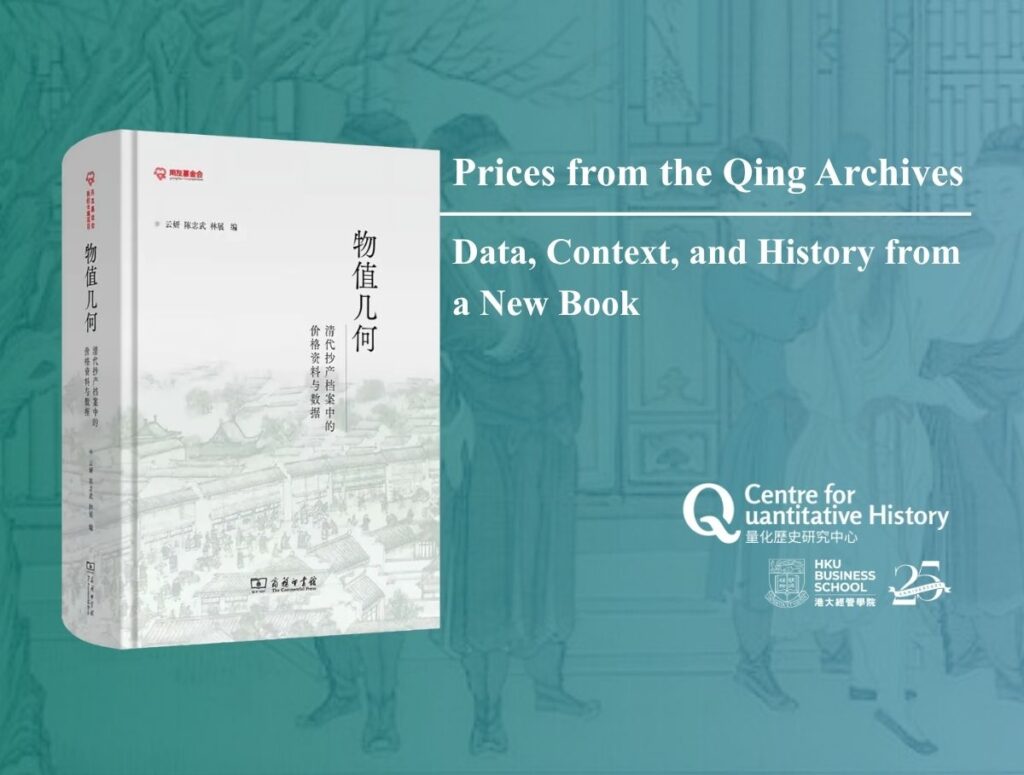
News由量化歷史研究中心主任陳志武、共同首席研究員林展與雲妍共同撰寫的學術著作《物值幾何:清代抄產檔案中的價格資料與數據》,結合豐富歷史紀錄和嚴謹數據分析,提供系統性的方法來理解清代資產與商品價值。 透過精心整理的檔案資料,作者彙集並對多個類別的價格資訊系統化處理,包括土地與房地產、奢侈品、日常必需品,以及商業與財務指標,讓讀者能「看見數據」與原始來源。本書為研究相關課題的專家提供額外參考資料,也讓讀者從清晰且引人入勝角度,了解清代的日常生活、物質文化與經濟史。
內容簡介
清代抄家案件頻繁,見於正式記錄的達2500餘案。 這些案件在清代宮廷檔案中留下許多詳細記錄,但長期以來各自分散,不成體系。 本書將各類抄產相關的檔案進行了歸類,提取整理出其中的價格數據,並繪製成表,首次有系統並集中地大量呈現了清代奢侈貴重品以及生活日用雜項等各類物品的價值。 全書分為田產,房產,奢侈品,生活日用品,商業金融數據補遺五章,並附僕婢人口價格,在製成數據表的同時,盡可能呈現史料的原貌,可為相關領域研究者及对此課題感興趣人士提供廣泛參考。
作者簡介
雲妍,清華大學歷史學博士。 曾先後在清華大學人文社會科學學院經濟學研究所,英國牛津大學歷史系從事博士後研究。 現任中國社會科學院近代史研究所副研究員。 主要研究領域為中國近代經濟史。
陳志武,現任香港大學經管學院金融學講座教授,鄭裕彤基金教授(金融學),同時擔任香港人文社會研究所所長和量化歷史研究中心主任; 之前曾在耶魯大學擔任金融經濟學教授18年。 主要研究工作涵蓋金融學理論、金融社會學、經濟史、量化歷史、新興市場、中國經濟和資本市場等課題。
林展,中國人民大學清史研究所副教授,兼任《清史研究》雜誌編委、副主編,《量化歷史研究》共同主編,香港大學量化歷史研究中心研究員。 長期從事金融發展史、長期生活水準變遷、不平等、海洋貿易史等研究。
The Centre for Quantitative History (CQH) is delighted to present《物值幾何:清代抄產檔案中的價格資料與數據》—a major scholarly work that brings together rich historical records and rigorous data-based analysis. Written by our Director, Zhiwu Chen, as well as our Co-Principal Investigator, Zhan Lin, together with their co-author, Yan Yun, the book offers a systematic approach to understanding Qing-dynasty asset and commodity values.
Through carefully organised archival materials, the authors compile and structure price information across multiple categories—including land and property, luxury goods, daily necessities, and additional references for commercial and financial indicators—allowing readers to “see the data” alongside the original sources. Beyond its value for specialists, the book also provides a clear and engaging window into everyday life, material culture, and economic history.
What were things worth? Price data from Qing-dynasty property confiscation archives
Property confiscation was a frequent occurrence in the Qing dynasty, with more than 2,500 cases recorded in official documents. These cases left behind unusually detailed inventories of household assets, preserved across palace memorials, government files, and Imperial Household Department archives.
This book brings these scattered records together for the first time, extracting and organising their rich price data into a systematic reference work. Covering everything from land, houses, luxury goods, jewellery, textiles, antiques, furniture, and everyday necessities to servants, loan rates, currency conversion, and shop capital, it opens a rare window onto the material and economic life of Qing China.
Based largely on confiscation archives, and supplemented by pawnshop manuals, official procurement records, diaries, and private notes, the volume presents thousands of historical prices while preserving the original wording of the sources wherever possible.
Key features
- Over 340 entries on land prices
- Over 580 entries on housing prices
- More than 1,900 entries on luxury goods
- More than 3,560 entries on daily necessities and consumer goods
- Over 270 entries on commercial and financial data
- Includes data on servant and bondservant prices
- Draws on rare Qing archival materials and market-related sources
Leading scholars advancing Quantitative History research
Contributors include leading experts in quantitative historical research on China, drawing on newly developed large-scale datasets. It is worth noting that some of the articles were co-authored by our team together with research students, reflecting our commitment to collaborative scholarship and training the next generation of researchers. Taken together, these studies highlight the transformative potential of big data and quantitative analysis in answering fundamental questions about the interplay between institutions, state capacity, and socioeconomic change across centuries.
Why this book matters
How much was a jade ornament, a fur coat, a courtyard house, a pearl necklace, a bolt of silk, or a bowl of rice worth in Qing China? Until now, prices for many luxury goods and everyday objects have remained fragmentary and difficult to access.
This volume fills an important gap by offering a concentrated body of price data for the study of Qing economic history, material culture, living standards, consumption, urban life, fashion, collecting, and social hierarchy. It is both a research tool and an engaging guide for readers interested in the everyday and extraordinary objects that shaped life in late imperial China.
By comparing official valuations, market prices, and private records, the book also helps readers better understand the complexities of Qing pricing systems, including silver-based accounting, regional currencies, official valuations, and real market transactions.
About the authors
Yan Yun received her PhD in History from Tsinghua University. She previously conducted postdoctoral research at the Institute of Economics, School of Humanities and Social Sciences, Tsinghua University, and in the Faculty of History at the University of Oxford. She is currently an Associate Research Fellow at the Institute of Modern History, Chinese Academy of Social Sciences. Her main research field is modern Chinese economic history.
Zhiwu Chen is Chair Professor of Finance and Cheng Yu-Tung Professor in Finance at the HKU Business School. He also serves as Director of the Centre for Quantitative History and Director of the Hong Kong Institute for the Humanities and Social Sciences. Before joining HKU, he was Professor of Finance at Yale University for 18 years. His research covers financial theory, financial sociology, economic history, quantitative history, emerging markets, the Chinese economy, and capital markets.
Zhan Lin is Associate Professor at the Institute of Qing History, Renmin University of China. He also serves as an editorial board member and Associate Editor of The Qing History Journal, Co-Editor of Quantitative History Research, and Fellow at the Centre for Quantitative History, The University of Hong Kong. His long-term research interests include the history of financial development, changes in long-term living standards, inequality, and maritime trade history.
About the book
Property confiscation cases were frequent during the Qing dynasty, with more than 2,500 cases documented in official records. These cases left behind many detailed records in the Qing imperial archives, yet the materials have long remained scattered and unsystematic.
This book brings together a wide range of archival materials related to property confiscation, extracts and organises the price data contained in them, and presents the data in tabular form. For the first time, it systematically and comprehensively showcases the value of various items in the Qing period, including luxury goods, valuables, everyday household items, and other miscellaneous objects.
The book is organised into five chapters: land, real estate, luxury goods, daily necessities, and supplementary data on commerce and finance. It also includes an appendix on the prices of servants and enslaved persons. While presenting the data in carefully compiled tables, the book also preserves the original form of the historical sources as much as possible. It offers a valuable reference for researchers in related fields as well as general readers interested in Qing history, economic history, and historical price data.
Suitable for
Researchers and students of Chinese history, economic history, material culture, Qing studies, financial history, urban history, and the history of consumption, as well as general readers interested in antiques, collecting, and daily life in imperial China.
Author(s)
CQH Communications Team