

Centre for Quantitative History

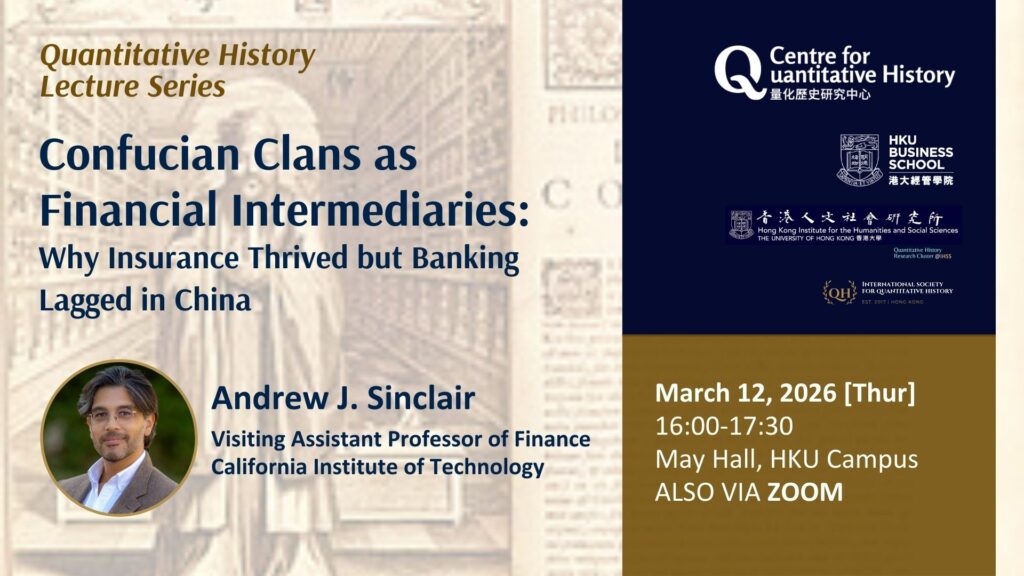
Confucian Clans as Financial Intermediaries: Why Insurance Thrived but Banking Lagged in China
Lectures

Confucian Clans as Financial Intermediaries: Why Insurance Thrived but Banking Lagged in China

Date(s)Date(s)

March 12, 2026

TimeTime

16:00 - 17:30

16:00 (Hong Kong/Beijing/Singapore)
04:00 (New York)
|
01:00 (Los Angeles)
|
08:00 (London)
|
17:00 (Tokyo)
|
19:00 (Sydney)
Venue

May Hall, HKU Campus

Language(s)Language(s)

English

Speaker(s) / Presenter(s)

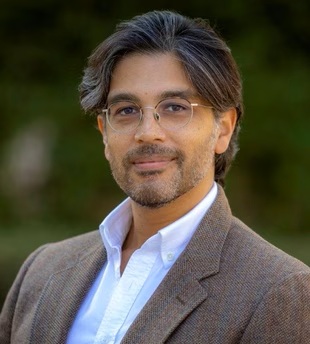
Andrew J. Sinclair

Visiting Assistant Professor of Finance
California Institute of Technology
Description

How do traditional institutions affect financial development? In late imperial China, the Confucian clan provided its members with resource pooling and risk sharing. While this institution inhibited the development of modern banking, it also supported the emergence of business enterprises at impressive scale. Andrew Sinclair of the California Institute of Technology and his co-authors study clans as business enterprises and analyze their demand for financial services. In particular, they model clans as financial intermediaries and show that these organizations had a demand for liquidity. Using novel prefecture-level data and an instrumental-variables strategy based on historical exposure to Zhu Xi’s influence, they present causal evidence that clans facilitated the development of the insurance industry in early twentieth-century China. The effects are strongest for property insurance and are amplified in disaster-prone regions. In this Quantitative History Lecture, Andrew Sinclair will explain in detail how their findings demonstrate that the path of financial development depends on whether new financial services compete with or complement existing institutional arrangements.

The lecture will also be livestreamed on Zoom as part of the Quantitative History Webinar Series. 

Andrew’s co-authors: Yaohua Li (SUFE) and Sicheng Zhao (Tsinghua)

Event Poster

About the Quantitative History Lecture Series

The Quantitative History Lecture Series is substantially supported by the Areas of Excellence (AoE) Scheme from the Research Grants Council of the Hong Kong Special Administrative Region, China (Project No. [AoE/B-704/22-R]).