



This event is coming soon
Register Date(s)
October 15, 2026
 Time
Time16:00 - 17:30
Zoom Webinar
 Language(s)
English
Speaker(s) / Presenter(s)

Research Postgraduate Student | PhD, Economic History (QH Research Cluster, IHSS, HKU)
Description
In this Quantitative History Webinar, Senhao Hu of Hong Kong Institute for the Humanities and Social Sciences (IHSS) will examine how ground-stone technology contributed to the rise of complex societies during the Neolithic.
The standard account—rooted in Gordon Childe’s productivity-channel hypothesis—argues that grinding improved farming implements and increased agricultural productivity, thereby generating food surpluses that supported population growth and complex-society development. In contrast, this study tests an alternative hypothesis: while agricultural and battlefield applications of the new technology both mattered for human welfare, the war channel was more decisive for the formation of complex societies. Specifically, more lethal stone weapons increased conflict threats, which in turn encouraged populations to agglomerate into larger, fortified settlements for defense—ultimately triggering social complexity.
Using the China Archaeological Database, this research analyzes a panel of 487 grid cells across “China Proper” over more than four millennia (6000–2000 BCE). The results show that, as a proxy for the war channel, stone-weapon grave goods consistently and significantly predict both the presence and intensity of large-settlement formation. By comparison, stone-farming-tool grave goods (a proxy for the productivity channel) do not show a comparable effect. Instrumental-variable estimations and two independent war-threat proxies—fortified cities and violence-caused skeletal injuries—further support the argument.
Importantly, the war channel through which ground-stone technology shaped complex-society development persists beyond the Neolithic, continuing through the Bronze Age (2000–770 BCE) and the Iron Age (770–221 BCE).
Senhao Hu’s co-author: Zhiwu Chen (HKU Business School and IHSS)
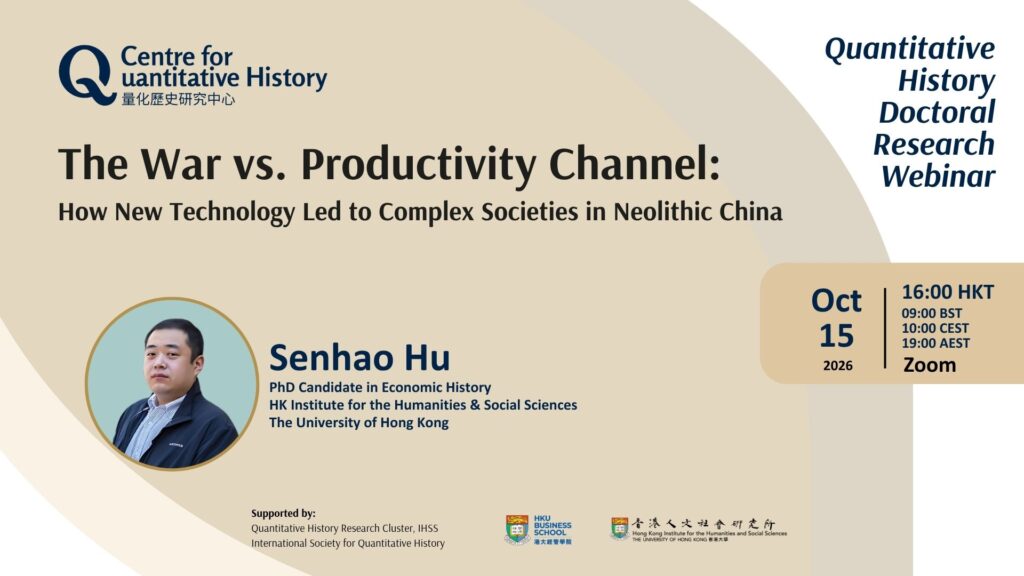
Event Poster
About the Quantitative History Webinar Series
The Quantitative History (QH) Webinar Series aims to provide researchers, teachers, and students with an online intellectual platform to keep up to date with the latest research in the field, promoting the dissemination of research findings and interdisciplinary use of quantitative methods in historical research. The QH Webinar Series, now entering its sixth year, is co-organized by the Centre for Quantitative History at the HKU Business School and the International Society for Quantitative History in partnership with the Hong Kong Institute for the Humanities and Social Sciences. The Series is now substantially supported by the Areas of Excellence (AoE) Scheme from the Research Grants Council of the Hong Kong Special Administrative Region, China (Project No. [AoE/B-704/22-R]).
量化歷史網上講座系列由香港大學陳志武和馬馳騁教授聯合發起,旨在介紹前沿量化歷史研究成果、促進同仁交流,推廣量化方法在歷史研究中的應用。本系列講座由香港大學經管學院量化歷史研究中心和國際量化歷史學會承辦,及香港人文社會研究所全力支持。從2023年開始,系列得到中國香港特別行政區研究資助局卓越學科領域計劃的重要資助 (項目編號[AoE/B-704/22-R])。
Conveners: Professors Zhiwu Chen & Chicheng Ma (HKU Business School)